NGO Registration & Trust Registration in Kolkata A Complete Legal Guide
In India, non-profit organizations are not just institutions—they are vehicles of social change. From education and healthcare to environmental protection and poverty alleviation, NGOs and trusts play a crucial role in national development. However, behind every successful non-profit lies a carefully structured legal foundation. Without proper registration, governance, and documentation, even the noblest mission can face legal roadblocks.
This guide is designed to give you a clear, legally accurate, and practical understanding of NGO registration and trust registration in Kolkata and across West Bengal. Written from a lawyer’s perspective, this article walks you through structures, laws, documentation, compliance, and common pitfalls, with a touch of human realism—because paperwork is serious, but learning it doesn’t have to be boring.
Understanding NGOs and Trusts in India
An NGO (Non-Governmental Organization) is not a single legal entity under Indian law. Instead, it can be registered under different legal frameworks depending on its purpose, governance style, and funding model.
Broadly, NGOs in India are registered as:
Each structure has distinct legal implications related to control, transparency, compliance burden, and funding eligibility.
Why Legal Registration Is Not Optional
Operating an NGO without registration is like driving a car without a number plate—you might move for a while, but you’re guaranteed to be stopped eventually.
Legal registration enables:
-
Opening a bank account in the NGO’s name
-
Receiving domestic and foreign donations
-
Applying for government grants
-
Claiming tax exemptions under Income Tax laws
-
Establishing credibility with donors and institutions
In short, registration is not just a formality—it is your NGO’s legal identity.
Choosing the Right Legal Structure
1. Trust Registration
A trust is typically formed for charitable or religious purposes and is governed by the Indian Trusts Act, 1882 (or relevant state acts).
Best suited for:
-
Family-run charities
-
Religious or philanthropic initiatives
-
Long-term asset holding
A trust is created by executing a legally enforceable trust deed, drafted with precision to avoid disputes or future compliance issues—this is where the role of a trust deed drafting advocate becomes legally significant.
2. Society Registration
Societies are governed by the Societies Registration Act, 1860, and in West Bengal, by state-specific amendments.
Best suited for:
-
Educational institutions
-
Cultural organizations
-
Membership-based NGOs
This model emphasizes democratic functioning and requires a managing committee.
3. Section 8 Company
A Section 8 Company is registered under the Companies Act, 2013.
Best suited for:
-
NGOs seeking high credibility
-
Organizations planning CSR funding
-
Institutions requiring structured governance
Though compliance-heavy, this structure is preferred by corporate donors due to its transparency.
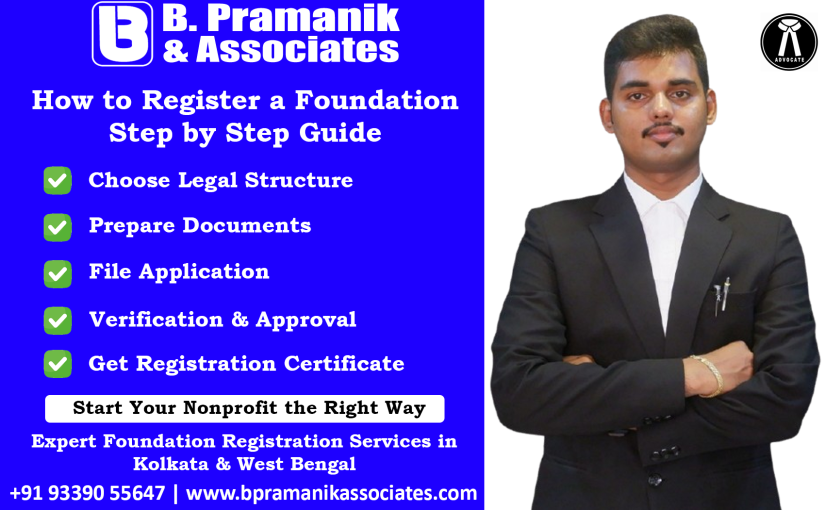
NGO Registration Process in West Bengal
The NGO registration process in West Bengal varies depending on the chosen structure but follows a systematic legal pathway.
Step 1: Define Objectives Clearly
Your objectives must be charitable, lawful, and clearly articulated. Vague intentions invite legal scrutiny.
Step 2: Identify Founders and Governing Body
Minimum requirements:
-
Trust: Minimum 2 trustees
-
Society: Minimum 7 members
-
Section 8 Company: Minimum 2 directors
Step 3: Name Selection
The name must not resemble existing entities or violate trademark laws.
Step 4: Draft Legal Documents
This includes Memorandum of Association, Rules & Regulations, or Trust Deed depending on structure.
Step 5: Registration with Authority
-
Trust: Registrar of Assurances
-
Society: Registrar of Societies
-
Section 8 Company: Ministry of Corporate Affairs
Importance of a Proper Trust Deed
A trust deed is not just a document—it is the constitution of the trust.
It defines:
-
Objectives
-
Powers of trustees
-
Appointment and removal clauses
-
Asset utilization
-
Dissolution procedure
Poor drafting can lead to internal conflicts, tax denial, or litigation. This is why professional legal drafting is not an expense—it’s insurance.
Public Charitable Trust Registration Explained
Public charitable trust registration is intended for organizations serving the public at large, not a closed group.
Key compliance elements include:
-
Stamp duty payment
-
Registration under the Registration Act
-
PAN and bank account
-
Income Tax registration
Courts often scrutinize charitable intent, making legal clarity essential.
Society Registration Under West Bengal Act
Society registration under West Bengal Act involves additional procedural compliance compared to trusts.
Key requirements:
-
Governing body resolution
-
Annual filing obligations
-
Regular member meetings
While slightly bureaucratic, societies offer flexibility in democratic decision-making.
Section 8 Company Incorporation: A Corporate Approach to Charity
Section 8 company incorporation blends social purpose with corporate governance.
Advantages:
-
Higher donor confidence
-
Strong compliance framework
-
Eligibility for CSR funding
Disadvantages:
-
Increased compliance
-
Annual filings and audits
This structure is ideal for NGOs planning scalable operations.
Tax Exemptions and Registrations
Registration alone does not grant tax benefits. NGOs must separately apply for:
-
PAN
-
Income Tax registration
-
Audit compliance
Failure to comply can result in penalties or cancellation of exemptions.
Common Legal Mistakes NGOs Make
Even well-intentioned founders often make avoidable legal errors:
-
Copy-paste objectives
-
Improper documentation
-
Ignoring post-registration compliance
-
Operating without legal advice
The law is forgiving only to those who respect it early.
Why Legal Guidance Matters
Navigating NGO laws requires not just form-filling, but legal foresight. Structuring today impacts compliance, funding, and governance tomorrow.
An experienced legal professional ensures:
-
Proper structuring
-
Drafting accuracy
-
Compliance readiness
-
Risk mitigation
In the long run, correct legal foundations save time, money, and reputation.
Final Thoughts
NGOs exist to serve society, but they must operate within the legal framework to sustain that service. Whether you’re setting up a charitable trust, society, or Section 8 company, informed decisions today prevent legal battles tomorrow.
At B. Pramanik & Associates, we believe social work deserves solid legal backing—because good intentions should never fail due to bad paperwork.
Contact Details
Advocate B Pramanik & Associates Law Firm
Salt Lake Office: First Floor – 211, SDF Building, Sector V, Salt Lake City, Kolkata – 700091, West Bengal (Monday to Saturday)
Dumdum Dum Office: 105/59, Dumdum Road, Kolkata – 700074 (Opposite Darao Pothik Bor Restaurant) Landmark – Dumdum Station, Suitable for Sunday and By Appointment only
Phone: +91 9339055647 | Support: +91 6291661951
Website: www.bpramanikassociates.com
Email: info@bpramanikassociates.com
Latest News



























































Looking For
Professional
Agency ?