NGO Registration in Kolkata: Legal Process Explained
Registering a non-governmental organization is not just a paperwork exercise—it is a legal foundation for social impact. Whether your objective is education, healthcare, women empowerment, environmental protection, or religious and charitable activities, the first legal step is correct registration.
In Kolkata and across West Bengal, NGO registration is governed by specific statutory laws, procedural compliance, and post-registration obligations. One small legal mistake today can invite notices, cancellation, or funding rejection tomorrow. This guide is written from a lawyer’s perspective, simplified for graduate-level readers, slightly humorous (because law is already serious enough), and fully informational.
What Is an NGO Under Indian Law?
An NGO (Non-Governmental Organization) is a non-profit legal entity formed for charitable, social, cultural, religious, or educational purposes. In India, NGOs do not have a single governing law. Instead, they are registered under different Acts, depending on the structure chosen.
An NGO cannot operate legally without registration. No registration means:
-
No bank account
-
No donations
-
No government grants
-
No credibility
In short: Good intentions + no registration = zero impact
Legal Structures Available for NGO Registration
In Kolkata, NGOs can be registered under three legally recognized formats:
Trust (Most Preferred for Charitable Work)
A Trust is governed by the Indian Trusts Act, 1882. It is ideal for:
-
Religious institutions
-
Educational charities
-
Healthcare initiatives
-
Family-based philanthropic activities
Minimum Members:
-
2 Trustees
Key Document:
-
Trust Deed (legally stamped and registered)
Society (Membership-Based NGOs)
Registered under the West Bengal Societies Registration Act, 1961, societies are suitable for:
-
Cultural associations
-
NGOs with democratic decision-making
-
Multiple founding members
Minimum Members:
-
7 persons
Section 8 Company (Most Compliant Structure)
Registered under the Companies Act, 2013, Section 8 Companies are ideal for:
-
Large-scale NGOs
-
CSR-funded organizations
-
International collaborations
Minimum Directors:
-
2 Directors
Yes, it sounds corporate—and yes, compliance is stricter—but credibility is unmatched.
Choosing the Right NGO Structure: Lawyer’s Insight
Here’s the legal truth (no sugar-coating):
-
Trust → Simple, fast, fewer compliances
-
Society → Democratic but slower
-
Section 8 → Highly credible but compliance-heavy
A wrong structure selection can cost years of operational difficulty. This is where most founders go wrong after watching one YouTube video at 2 AM.
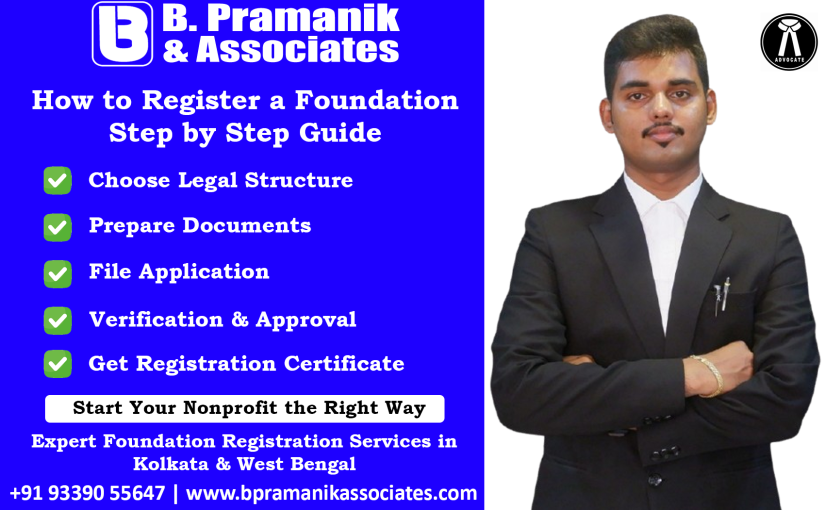
Step-by-Step NGO Registration Process in Kolkata
Now let’s get into the legal mechanics.
🔹 Step 1: Name Selection & Legal Verification
The NGO name must:
-
Not resemble an existing entity
-
Not violate Emblems and Names Act
-
Reflect charitable intent
Lawyers always conduct name availability checks to avoid rejection.
🔹 Step 2: Drafting the Governing Document
Depending on structure:
-
Trust → Trust Deed
-
Society → Memorandum & Rules
-
Section 8 → MOA & AOA
These documents define:
-
Objectives
-
Governance rules
-
Member powers
-
Dissolution clauses
Poor drafting = future disputes.
🔹 Step 3: Stamp Duty & Registration
In Kolkata:
-
Trust deeds are registered at the Registrar of Assurances
-
Societies at the Registrar of Societies
-
Section 8 via ROC (MCA Portal)
Stamp duty varies based on structure and property involvement.
🔹 Step 4: PAN, Bank Account & TAN
After registration:
-
Apply for PAN in NGO’s name
-
Open a current bank account
-
Obtain TAN if staff hiring is planned
Without PAN, your NGO legally does not exist for taxation.
Post-Registration Legal Compliance (Often Ignored)
Here’s where most NGOs become non-compliant unintentionally.
12A Registration (Income Tax Exemption)
Provides income tax exemption on surplus funds.
80G Registration (Donor Tax Benefit)
Allows donors to claim tax deductions.
Without 80G, donors hesitate. With 80G, donations increase.
FCRA Registration (Foreign Funding)
Mandatory for receiving foreign donations.
Requires:
-
Minimum 3 years of activity
-
Clean compliance history
No shortcuts here. The Home Ministry does not joke.
Common Legal Mistakes NGOs Make
From court files to real-life cases, here are frequent errors:
-
Using personal bank accounts
-
Copy-paste trust deeds
-
Ignoring annual filings
-
Accepting donations without receipts
-
Not maintaining minutes & records
These mistakes don’t look serious—until a legal notice arrives.
Why Legal Guidance Matters in NGO Registration
NGOs operate in public interest, but the law treats them with strict scrutiny because money, trust, and public faith are involved.
A lawyer ensures:
-
Correct structure
-
Legally enforceable documents
-
Long-term compliance safety
-
Eligibility for grants and CSR funds
Think of legal help as preventive medicine, not emergency surgery.
Final Thoughts
Registering an NGO is not about filling forms—it is about building a legally sustainable institution. A strong legal foundation ensures your social mission survives leadership changes, funding cycles, and regulatory audits.
And yes, social work is noble—but even nobility needs proper paperwork.
Contact Details
Advocate B Pramanik & Associates Law Firm
Salt Lake Office: First Floor – 211, SDF Building, Sector V, Salt Lake City, Kolkata – 700091, West Bengal (Monday to Saturday)
Dumdum Dum Office: 105/59, Dumdum Road, Kolkata – 700074 (Opposite Darao Pothik Bor Restaurant) Landmark – Dumdum Station Suitable for Sunday and By Appointment only
📞 Phone: +91 9339055647 | Support: +91 6291661951
🌐 Website: www.bpramanikassociates.com
📧 Email: info@bpramanikassociates.com
Latest News

































































Looking For
Professional
Agency ?